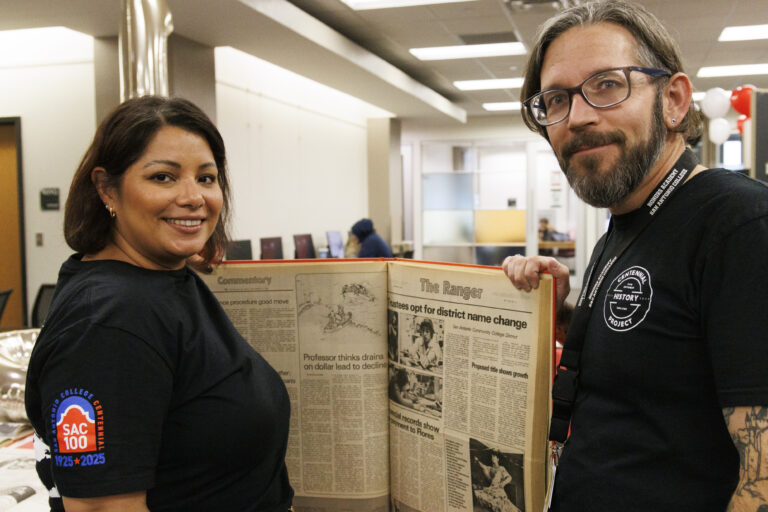
From left, Assistant Professors of History Dr. Laura Oviedo and Dr. Jecoa Ross, who coordinated the college’s Centennial Student Expo, pose Dec. 3 with archived issues of the Ranger, SAC’s student newspaper until 2020. Photo by Janelle Aleman.
Faculty members in SAC’s history and Mexican American studies programs celebrated 100 years of history at the college with a Centennial Student Expo Dec. 3-4, hosting panel discussions and presentations with students in seven academic disciplines in Moody Learning Center’s fourth-floor library.
A student panel titled Remembering Our Past opened the expoDec. 3. During breaks between student panels, organizers played episodes of the student-produced podcast Change the Ranger Campaign Oral History Project, which detailed the student-led campaign at SAC in 2020 to change the college’s mascot — then the SAC Rangers — and remove “theRanger” as the name of the college’s student news publication.
Beginning in 2019, Mexican-American Studies students objected to the mascot’s connection to the Texas Rangers who killed Mexicans and Native Americans in the early 1900s. In July 2020, a 60-member council of SAC faculty, staff and administrators voted unanimously to stop using the mascot name, image and logo.
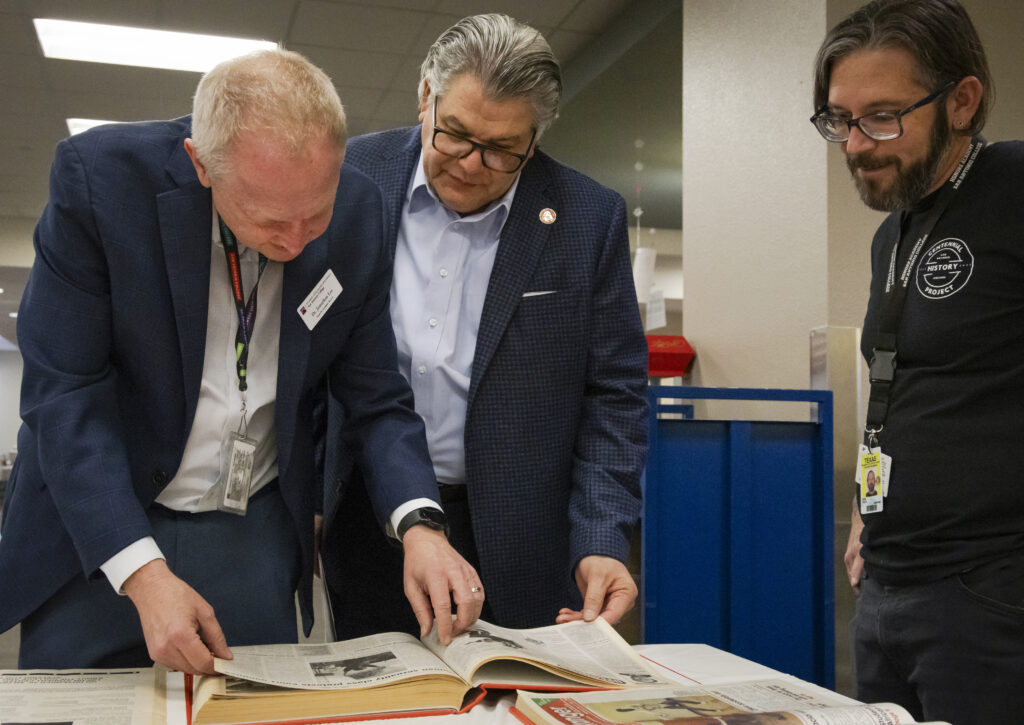
From left, Dr. Jonathan Lee, Dean for Academic Success at San Antonio College; SAC President Dr. Francisco Solis, and Assistant Professor of History Dr. Jecoa Ross, look through archives of the Ranger, SAC’s student newspaper until 2020, during the college’s Centennial Student Expo in the library Dec. 3. Photo by Janelle Aleman.
“I think the Student Expo is important because it showcases all of the work that students are doing and have been doing,” Dr. Jecoa Ross, assistant professor of history and one of the expo organizers, told theSundial. “We really haven’t, as a college, had a space to lift that up.”
Dr. Laura Oviedo, assistant professor of history and Mexican-American studies, coordinated the expo with Ross. She said her goal was to get students involved with the college’s centennial celebration by having them make historical content.
“We wanted to see how staff, students and everyday people in the community could engage and offer their stories and experiences within San Antonio College, past or present,” Oviedo said.
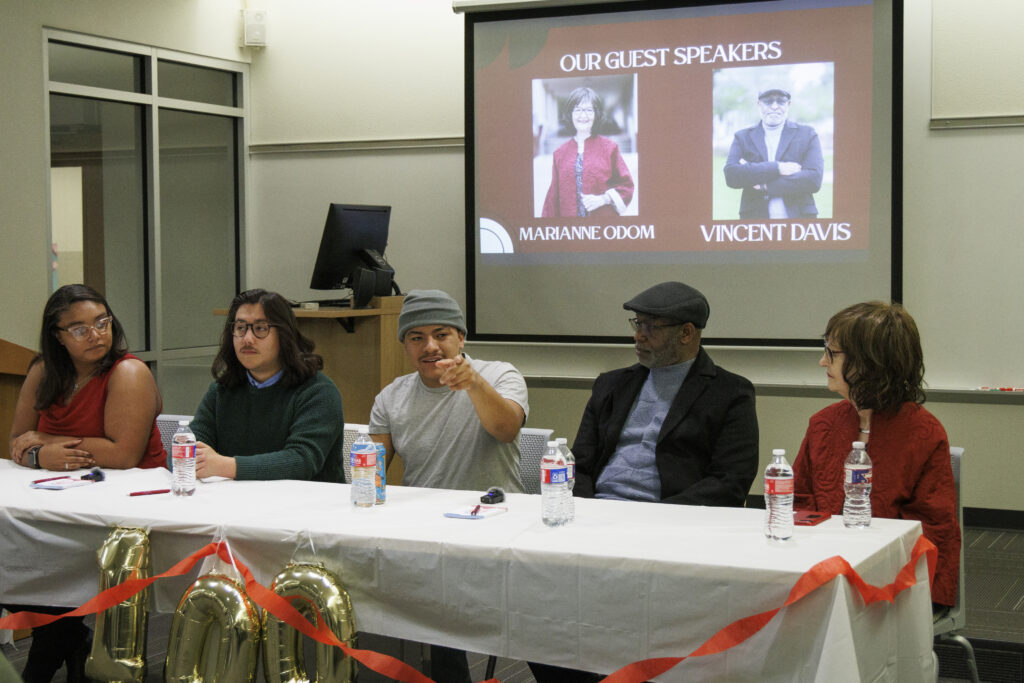
From left, Sundial Editor-in-Chief Natalia Edwards, Sundial Assistant Managing Editor Aaron Martinez and Sundial Photo Editor Jacob Lopez joined SAC Alum Vincent Davis, a reporter and columnist for the San Antonio Express-News, and retired SAC Journalism Professor Marianne Odom for a panel discussion at the college’s Centennial Student Expo in the library Dec. 3. Photo by Janelle Aleman.
Various organizations displayed content representing their values and focus. Members of Rho Sigma Gamma, a student organization focused on mortuary science, talked about their passion to serve the dead and those who have lost loved ones.
One student panel — History Lessons: Connecting Current Issues to US History up to 1877 — featured a presentation on federal funding and education.
“It was really interesting to see these different viewpoints and presentations, types of research and thought processes that went into each individual project and their insights.” Dual-credit student Keon McDowell told TheSundial.
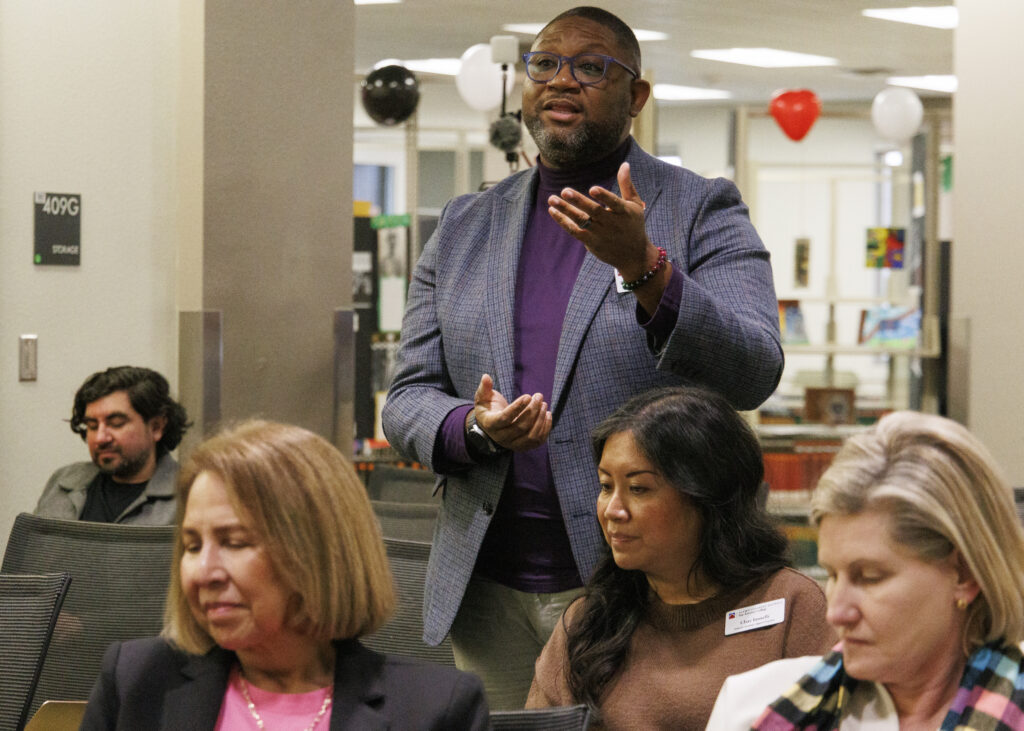
Dr. Gourjoine M. Wade, Vice President for Student Success at SAC, asks a question during a panel discussion at the college’s Centennial Student Expo in the library Dec. 3. Photo by Janelle Aleman.
Several Sundial editors participated in a panel discussion with retired SAC Journalism Professor Marianne Odom and SAC alum Vincent Davis, a reporter and columnist for the San Antonio Express-News. The panel showcased student work from the fall semester and discussed the importance of student journalism and its role in documenting history.
“Although the journalism program shuttered temporarily, this semester feels like we’re really laying the foundation to recreate something — a program, a community, an online publication — for future journalists, who we want to inspire,” Assistant Managing Editor Aaron Martinez said. “We want to keep student and local journalism alive.”
On Thursday, the first student panel opened with history students reading handwritten essays from incarcerated students enrolled at SAC as part of the the Texas Education Justice Alliance South — a partnership between SAC, the University of Texas San Antonio, and the Texas Department of Criminal Justice. The program allows inmates incarcerated at the Dominguez State Jail to pursue higher education.
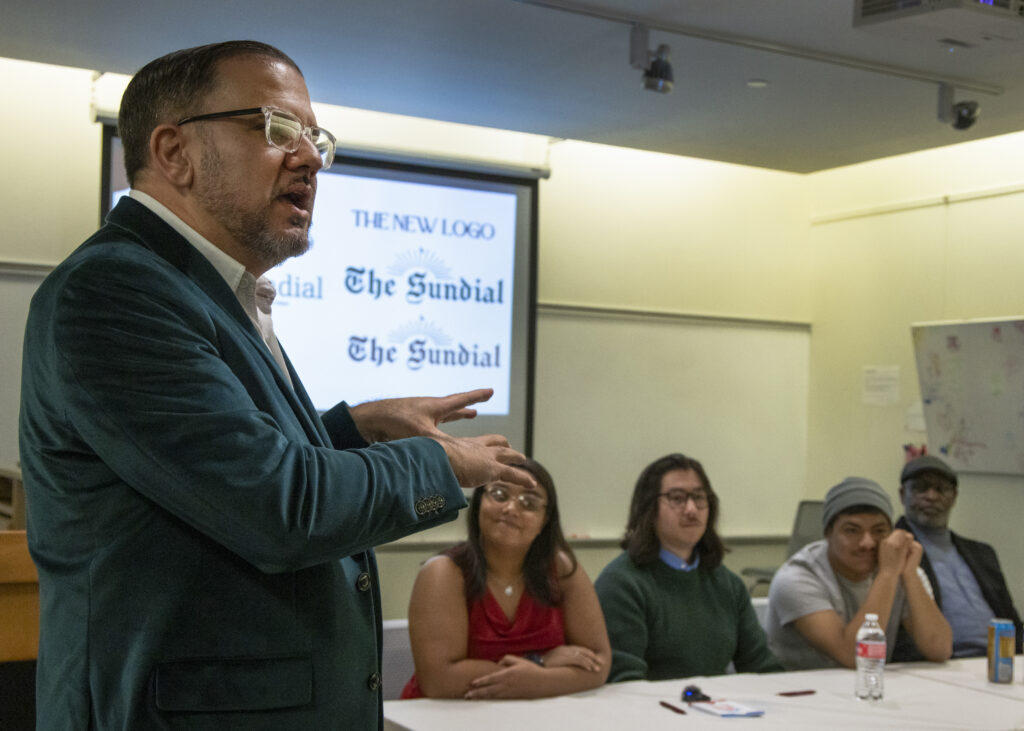
Journalism Instructor Ethan E. Rocke speaks during a panel discussion with Sundial editors, retired SAC Journalism Professor Marianne Odom, and SAC Alum Vincent Davis, a reporter and columnist for the San Antonio Express-News, at the college’s Centennial Student Expo in the library Dec. 3. Photo by Janelle Aleman.
“It opens up a conversation about education and who has access to it … A lot of incarcerated people do not have the resources, and that can lead to decisions that are not well thought out,” Paulina Mamani, an international studies student, told theSundial. “I think it shows there’s so many well-spoken people behind bars, and it’s important to showcase their work too.”
Students taking a Mexican American Studies course reflected on the life and legacy of Gus Garcia, a civil rights attorney. They highlighted his efforts to fight the segregation that Mexican Americans faced in the 1900s and discussed how Mexican Americans were legally considered white under treaties such as the Treaty of Guadalupe Hidalgo (1848) but didn’t enjoy the same benefits as their white counterparts.
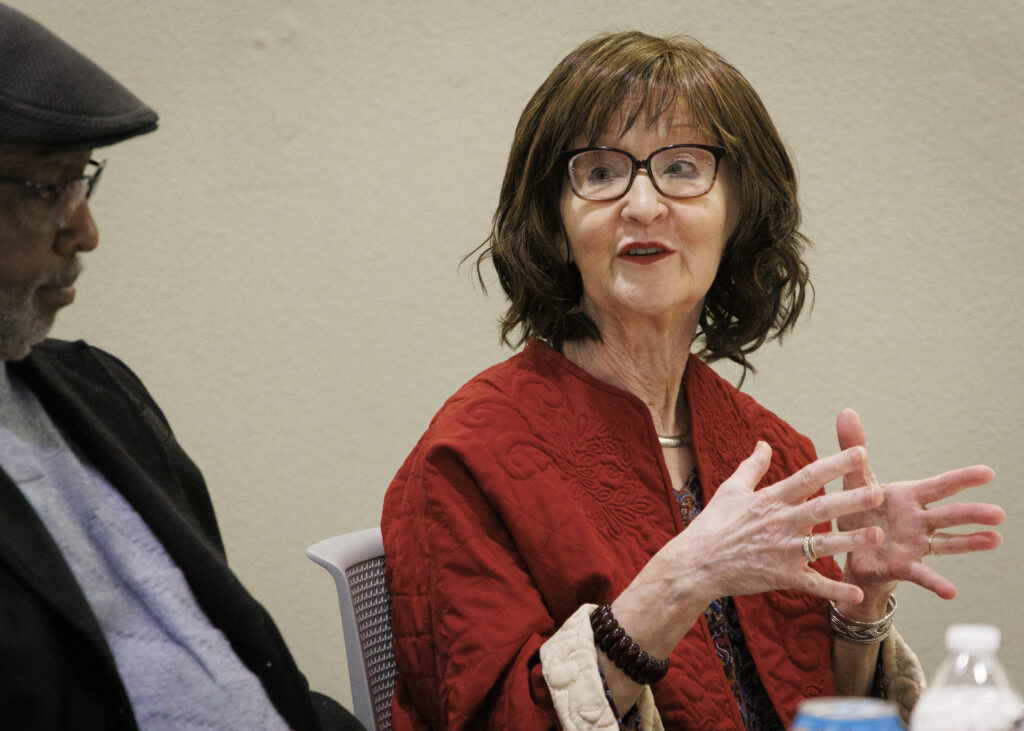
Retired SAC Journalism Professor Marianne Odom speaks during a panel discussion at the college’s Centennial Student Expo in the library Dec. 3. Photo by Janelle Aleman.
“It’s great to highlight all of the coursework that students have done around the centennial history project,” History Professor and co-coordinator of Mexican and History Studies Dr. Mary Ann Bueno told the Sundial. “They’ve really done a great job of disrupting the dominant narrative of SAC and capturing what historians called history from the bottom up — the history of SAC from the everyday perspective, and not necessarily just the perspective of leaders.”
The student expo was one of many events celebrating SAC’s centennial. Those interested can find more information on upcoming events and news regarding the centennial here.